
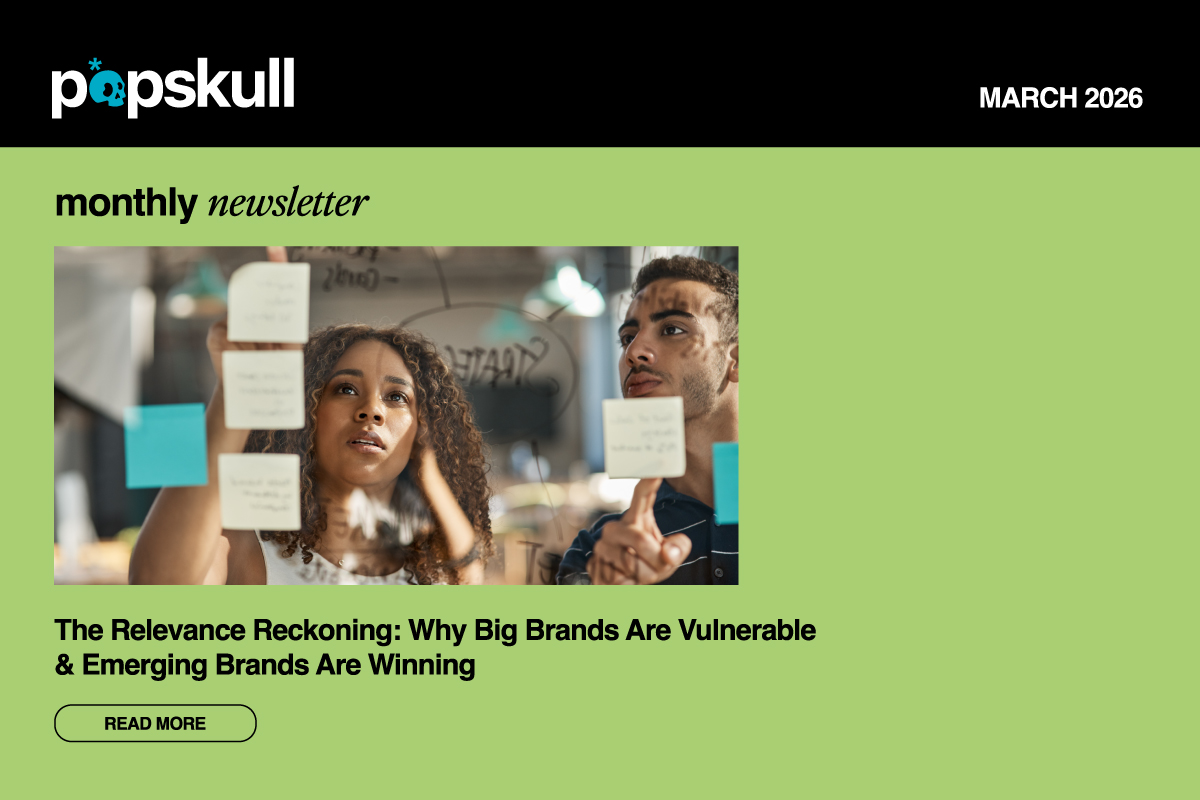
The days of big CPG brands dominating store shelves are over. In today’s market, legacy players are losing ground to emerging challengers at an accelerating rate. EY puts it bluntly: the growth model that powered large consumer products companies for decades is breaking down. In many categories, there may soon be room for only one mass-market brand, with the rest of the shelf space going to private label and niche disruptors. Big brands are losing relevance – fast. And most are ill-equipped to win it back.
Since 2009, our agency has helped dozens of early-stage and emerging brands across B2B and B2C challenge and take market share from entrenched competitors. We’ve seen firsthand how upstart brands connect with consumers in powerful ways that legacy players haven’t been able or willing to replicate. The legacy brands don’t have a resource problem. So what is the issue?
The Internet Changed the Game. Consumer Sentiment Took It From There.
Practically overnight, the internet made it possible for new brands to find their audiences at scale without relying on mass media gatekeepers. A craft seltzer brand can now build a loyal community through organic social content, while a clean beauty startup can gain traction through influencer partnerships. Social media didn’t just give emerging brands a way to reach consumers – it gave consumers the power to elevate brands that resonate through shares, reviews, and user-generated content.
This shift in media landscape triggered a shift in sentiment. According to Forrester, 65% of US consumers now trust what influencers say about brands more than what brands say about themselves. Trust in traditional advertising is eroding across generations. Only 1 in 4 Baby Boomers, historically the most brand loyal cohort, say they buy from a brand because they’ve used it in the past.
The Gap Is No Longer Generational.
In fact, consumers across age groups are looking for products that align with their values and identities. They want to feel an authentic connection, a sense of community, a reflection of who they are – not just what they buy. Consumers still value brands, but they expect more: a brand that connects with them in a unique, relevant, and emotional way. One that they can feel being a part of. Consumers are fatigued by generic corporate messaging and instead gravitate toward brands that are transparent, genuine, and unapologetic about their mission and identity. Similarly, emerging brands, by their very nature, must operate from a place of truth and conviction to disrupt established markets.
The result is a dynamic where emerging brands and modern consumers find connection through a deep, shared ethos. It’s this shared open-to-trying-new-things ethos that rejects the status quo. RX Bar, SkinnyPop, Dollar Shave Club…a new generation of brands has won big by aligning with evolving consumer values and leveraging technology to build direct relationships at scale.
This ethos is untouchable to Big CPG that are seen as conglomerates peddling generic products and corporate values. In a Deloitte study, the top reason consumers cited for trying a new brand was “they treat me as an individual, not just another consumer.” Emerging brands are winning by making consumers feel seen, understood, and emotionally invested – not just marketed to.
“Innovation” Alone Won’t Save Legacy Brands
When market share erodes, the knee-jerk response from big brands is often to crank out line extensions, push into new channels, and ramp up trade spend. But these moves are band-aids, not breakthroughs. Launching a me-too product or colonizing another shelf can prop up sales in the short-term. But it does nothing to rebuild relevance in the long-term. EY notes that consumers are becoming innovation skeptics, and a large share of consumers interpret “improvements” as cost-cutting exercises rather than real value. That is brutal, because it means some of the biggest brands are spending money to remind people they are not trying anymore.
Even splashy innovations are falling flat if they feel inauthentic or off-brand. Kraft Heinz’s Oprah-branded frozen cauliflower crust pizza and PepsiCo’s Drinkfinity pod-based beverage system were costly launches designed to chase health trends. Both failed to gain traction and were discontinued within two years. The lesson? Consumers see through attempts by legacy brands to mimic challenger brands if the efforts aren’t credible and true to their core ethos.
Emerging Brands Are Built for Today’s Consumer
Unburdened by sprawling product lines and calcified ways of working, emerging brands are able to focus relentlessly on creating elevated products and experiences that sync with modern consumer needs:
-
-
Natural ingredients and transparent sourcing. Olipop, the prebiotic soda brand, has expanded rapidly while maintaining its commitment to plant-based ingredients that support digestive health. Partake Foods, known for its allergy-friendly cookies and baking mixes, has grown its distribution to over 10,000 stores while continuing to source non-GMO, gluten-free ingredients.
-
Customization and inclusivity. Function of Beauty, the personalized haircare brand, has extended its customization capabilities to skincare and body care, using AI to analyze customer selfies and generate tailored product recommendations. Prose, another leader in custom haircare, has partnered with salons nationwide to offer in-person consultations and product refills, enhancing its omnichannel personalization.
-
Direct relationships and feedback loops. Haus, the DTC aperitif brand, has built a loyal following through its “Haus Hosts” program, which recruits customers to throw branded tasting events and gather real-time feedback on new product ideas. Judy, the emergency preparedness brand, has used its text message-based concierge service to provide timely, personalized support during natural disasters, strengthening customer relationships
-
Alignment with consumer values. Bombas, the sock brand that donates an item for every item purchased, has expanded into underwear and t-shirts while staying true to its mission, having donated over 100 million items to homeless shelters to date. Who Gives a Crap, the eco-friendly toilet paper brand that builds toilets in developing countries, has seen sales soar as consumers prioritize brands with a strong social and environmental impact.
-
Big Brands Have an Authenticity Problem
Brand building today is not about crafting a narrative, it’s about living one authentically. When legacy brands try to retrofit themselves into something they’re not, consumers don’t buy it.
Attempts to quickly turn the ship – an on-trend acquisition, a packaging refresh, a “now with 50% less sugar!” claim – can actually backfire. The more a legacy brand contorts to chase an emerging brand, the more it reminds people how out of touch it was in the first place.
This is the paradox that paralyzes big brands: the assets they’ve long relied on for an advantage, like a widely recognized logo or a category-defining product, have gone from signaling heritage to signaling baggage in consumers’ minds. The brand itself feels trapped in amber – pleasant but dated, ubiquitous but stagnant. No amount of innovation can overcome the dead weight of a brand that has lost meaning.
The Future of CPG Won’t Be Won by Scale Alone
EY is right that in many categories, “only one brand will maintain broad distribution and mass market scale in-store.” But that doesn’t mean what it used to. Holding on to 80% all-commodity volume doesn’t guarantee long-term success if the remaining 20% of challenger brands are the ones capturing all the excitement, growth, and consumer love.
This is especially true as more shelf space converts to private label, which is outpacing branded products in several categories. To avoid getting squeezed between aggressive retailers and nimble upstarts, big brands need to make an honest accounting of their relevance and resonance.
Market share is not mind share. Brands that endure prioritize emotional equity over efficiency every time. They sacrifice easy margin expansion for bold moves that shake up categories. And they never, ever chase the competition when they could be setting the pace.
What Big Brands and Emerging Brands Should Do Now
For legacy brands, it’s time for radical focus and creative destruction. This means:
- Auditing the portfolio to assess what’s pulling the brand forward versus dragging it back. Be ruthless about cutting loose products and positionings that aren’t future-proofed.
- Identifying the brand’s core essence – the heartbeat that makes it irreplaceable in consumers’ lives. Build everything around reinforcing this unique emotional core.
- Divesting to invest. Unload assets that don’t fit the go-forward vision to free up resources for fewer, bigger, braver bets with the potential to redefine the category.
- Bringing in outside perspectives, from frontline employees to passionate consumers. Rebuild from a place of empathy and imagination, not legacy process and playbooks.
For emerging brands, now is the time to take risks, not take prisoners. This means:
- Never chasing someone else’s idea of success. Define your own norms and KPIs based on building deep affinity with your tribe.
- Prioritizing clarity and creativity over reacting to every competitor move. Constraints foster focus. Obsess less over incremental growth and more over making each brand touch point count.
- Staying close to the consumer to spot opportunities others miss. Use your agility as an advantage to address unmet needs and pioneer new experiences.
- Protecting your culture as you scale. Hire for heart, promote from within, and never let systems trump soul.
A New Era of Relevance
Big CPGs are used to attacking business problems with business solutions – operational efficiency, pricing optimization, promotional spend. But the challenge they face now is fundamentally human, not financial. No amount of supply chain savvy can fix a broken emotional bond.
The emerging brands that are winning aren’t doing so by accident or even by product superiority alone. They’re winning by treating consumers as co-conspirators, by making them feel part of something bigger than a transaction. They’re winning through empathy, authenticity and, above all, humanity.
Because in a world where consumers have infinite choice, the brands that choose to be meaningful are the ones that endure. Everything else is just a race to the bottom.
And as always, we’d love to hear your take. What resonated? What did we miss? Email us at info@popskullchicago.com and let us know. Let’s keep the conversation going.
0 Comments